How to Build a Restaurant Email List You Actually Own
“Restaurant email list” means two very different things, and which one you want decides whether this page is worth your time. One is a file of restaurant addresses sold by a data broker, bought by people who want to pitch restaurants. The other is a list of your own guests — people who ate at your place and said yes to hearing from you again. This page is about the second one, and about why the first one is a bad trade.
Two kinds of “restaurant email list”
The confusion is not your fault. Both things get called the same name, they both arrive as a spreadsheet, and only one starts with a relationship between you and the people on it.
| The difference | A list you buy | A list you build |
|---|---|---|
| Whose guests are on it | Someone else’s | Yours |
| Did they agree to hear from you | Unknown, usually no | Yes, at the moment of signup |
| What happens on the first send | Risk of complaints and spam placement | A message guests asked to receive |
| What you can do with it next month | Permission is still unproven | Send again while permission remains valid |
| Who controls the relationship | A broker supplies the addresses | You manage the list and its consent records |
If you are looking for the first kind — a file of restaurant contacts to cold-email — those exist, and this is not the page for them. If you run a restaurant, a café, a bar or a small group of them, the rest of this page is about a list that can still be worth something to you in six months.
Why buying a list costs more than it saves
A purchased list looks cheap: a few hundred dollars for a few thousand addresses. The price on the invoice leaves out the risk to your sending reputation.
The real cost is your domain’s reputation
Send to people who never asked to hear from you and complaints can affect delivery of later messages, including messages your real guests requested. Gmail’s bulk-sender rules include SPF, DKIM and DMARC authentication, one-click unsubscribe for marketing mail, and spam rates below 0.3%. These are delivery requirements, not a guarantee of inbox placement. Read Google’s sender guidelines.
Be precise about the rules
In the United States, CAN-SPAM does not generally require prior opt-in. It does require truthful sender and subject information, advertising disclosure, a valid postal address and a working opt-out, honored within ten business days. Buying a list does not remove those duties. See the FTC’s CAN-SPAM guide.
Canada’s CASL generally requires consent, which can be express or implied under specific conditions, plus sender identification and an unsubscribe mechanism. EU electronic-marketing rules generally require prior consent for individual subscribers, with a limited existing-customer exception for similar products; national implementation and GDPR obligations also matter. Email providers can apply stricter rules. CRTC consent guidance · EU ePrivacy Directive, Article 13.
Ask where each address came from and what the person agreed to. If you cannot answer that, a spreadsheet is not a ready-to-send audience.
A bought list is missing one fact
The list you build contains an address plus the fact that this person sat at your table, ordered the short rib, and liked it enough to hear from you again. That relationship is the reason email can work for restaurants. An address on its own has no memory of you.
Where the addresses actually come from
Six places, in a practical order to test. Each is a moment when a guest already has a reason to know you. Start with one collection point before trying to run all six as part of your restaurant marketing.
1. A QR card on every table
A small card, one line of copy, one QR code, no app to download. The landing page should load quickly on restaurant Wi-Fi or people put the phone back down. Print a reason on the card, not just a request: what they get for signing up. For a full-service restaurant, this is a straightforward place to start.
2. A card with the check
The guest has decided they are happy; they are waiting anyway; there is a moment to scan. A card the size of a business card with a QR code and a clear offer can work well here. Test it against the table card: the guest is no longer distracted by food or conversation.
3. Your Wi-Fi signup page
If guests already ask for the Wi-Fi password, you already have a useful place to make the invitation. Offer an optional email signup alongside access to the network. Keep the plain password visible too: guests who do not want marketing must not be locked out. Access to Wi-Fi and permission to send offers are separate choices.
4. Events, private dining, and ticketed nights
Every reservation, prix fixe dinner, wine flight and ticketed event has a guest list attached to it — and a natural follow-up. Ask separately for marketing permission at booking. A reservation address is not automatically a newsletter subscriber. Follow up within the scope of what guests requested, and let them choose whether to hear about the next event.
5. Staff, in one sentence
A script nobody uses is worse than nothing. One sentence, at the moment the plate is cleared: “If you scan the card, we’ll send you the new menu before it goes public.” Ask staff to try it at one table per shift. Consistency beats coverage; nobody should have to insist when a guest says no.
6. Takeout bags and receipts
Guests who order takeout are still your guests, and they may have fewer reminders of you between orders. A sticker on the bag, a line on the receipt, a QR code on the lid: a low-cost collection point that keeps working while you are busy in the kitchen. Make the reason to scan clear before the bag leaves the counter.
What to give in exchange
The default everyone reaches for is a discount on this visit. That rewards a purchase the guest has already decided to make. A reason to come back can do a different job: give the next visit a date and a concrete thing to look forward to.
Try an offer attached to a specific experience rather than relying on a percentage:
| Instead of | Write this |
|---|---|
| 20% off your meal | A free glass of wine on your next visit |
| 15% off total bill | The dessert that is not on the menu yet, next time |
| Happy hour discount | A table held for you on a Tuesday |
| $10 off $50 | Bring a friend, both starters are on us |
Four rules for a useful offer
One: make it for the next visit. Two: give it an expiry date; fourteen to twenty-one days is a starting point to test. Three: name something guests can picture, rather than only a percentage. Four: avoid a minimum spend when your margins allow, or state it clearly before signup. The offer should be worth returning for, with terms your team can honor.
The signup page itself
Four things decide whether the page is easy to use, and three of them are subtractions.
One screen, a phone, one field
Ask for an email address and nothing else you do not need. First name, birthday, party size, “how did you hear about us” — every additional field is more work. If you want a birthday later, ask after the relationship exists.
Say what you will send, and how often
“One email every two weeks, with what’s new on the menu and first access to events.” A guest who knows what is coming does not feel tricked by the first send. Only promise a schedule and content you can deliver. Keep marketing signup an explicit choice, separate from claiming an offer.
Use a plain privacy promise
Explain who will use the address and why, link to your privacy information, and make leaving easy. “Unsubscribe in one click, any time” is useful when it matches what your system actually does. A short explanation helps guests understand their choice; it does not replace the privacy information you need to provide.
Do not skip confirmation
A confirmation email helps filter mistyped addresses and records that the person controls the inbox. Keep the signup wording, time and source alongside that record. Verifying an address by itself does not establish marketing permission: the guest must also have agreed to receive marketing from you.
How large the list should be by month three
There is no single average worth holding your restaurant to. Start with your own capacity and a clearly labeled assumption for how many guests will choose to sign up.
Seats × turns per day × capture rate × days open = estimated signups per month
| Your place | Seats | Turns/day | Capture rate | Signups/month |
|---|---|---|---|---|
| Neighbourhood café | 40 | 3.0 | 15% | 540 |
| 60-seat bistro | 60 | 1.5 | 10% | 270 |
| 120-seat, dinner only | 120 | 1.2 | 8% | ≈346 |
These are opportunities for signups, not a promise of that many unique new subscribers. Repeat guests, duplicate addresses and unconfirmed signups reduce the total. Month three is not simply month one multiplied by three.
Capture rate is the useful number to test first. Count unique, confirmed marketing signups for thirty days and divide by covers. If results disappoint, change one thing — the offer, wording or placement — and measure again. A smaller, willing audience is more useful than a bigger list whose permission you cannot establish.
Put the collection point, owner and weekly number into your restaurant marketing plan.
What to send, and how often
Every two weeks is a practical starting rhythm for a single-location restaurant. Weekly is possible when you have something useful to say; once a quarter makes it harder to stay familiar. The bigger risk is becoming the restaurant that only emails when it wants something.
| Type | How often | What it does |
|---|---|---|
| What’s new — a dish, a seasonal menu, a new wine | Most sends | Gives a reason to come back that is not a discount |
| A specific night — an event, a guest chef, a tasting | Monthly | Fills the emptiest slot in your week |
| The people — a regular’s story, the kitchen, a supplier | Quarterly | Makes the list feel like it is from humans |
| A next-visit offer | Every second or third send | Turns reading into a reason to book |
Two details that make the habit work
Keep the unsubscribe link easy to find, and process requests promptly. Making someone work to leave is a quick route to a complaint.
Write the subject line last, after the body, so it describes what is actually inside. Restaurant subject lines fail when they are too clever to understand or so generic that they look like a receipt.
Choose the audience, reason to return and measurement before picking a sending schedule. That is the foundation of your restaurant marketing strategy.
Keeping the list clean
Your list is an asset with a maintenance schedule, and it degrades silently.
Unsubscribes take effect at once
Make the action easy and suppress further marketing as soon as the request arrives. Do not ask a guest to log in, fill out a survey or explain why they are leaving.
Hard bounces come off automatically
Suppress permanently undeliverable addresses when the hard bounce arrives; do not keep trying them. Temporary delivery failures are different and should follow your provider’s retry policy.
Keep the consent record with the list
Store what the guest agreed to, when and where, with their current subscription status. Preserve suppression records when moving providers so an old export cannot accidentally resubscribe someone.
Split out the dormant ones
Review people who have stopped responding, using clicks, replies and visits as well as opens. Open tracking is not a reliable measure on its own. Where you still have valid permission, a quiet re-engagement message can help; then reduce frequency or stop marketing to people who remain inactive.
Where DineSend fits
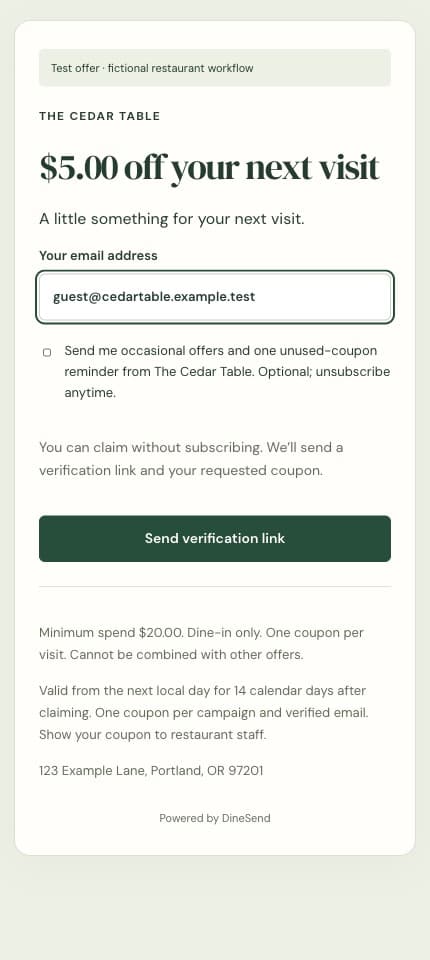
Two of the six collection points above are the ones we built for — the table card and the check card — along with the offer that gives guests a reason to return.
- A signup page for each offer — a guest link, a QR code and a printable offer to share at the table or with the check
- Verified addresses, a separate marketing choice — guests verify their email to receive a coupon. Verifying an address does not subscribe the guest to marketing.
- A next-visit coupon with a deadline — choose a discount or free item, state the conditions, and have signed-in staff redeem it
- Redemption, not just opens — see coupons issued and redeemed, alongside verified claimants and marketing subscribers
FAQ
Can I just buy a restaurant email list?
You can buy addresses; what you cannot assume is permission. A purchased list may contain people who never agreed to hear from you, and sending to them risks complaints and damage to your sending reputation. Building a list from your own guests is slower, but gives you a relationship and a record of what they agreed to receive.
How many signups should we get per month?
Work it out from your own room: seats × turns per day × capture rate × days open. A 60-seat restaurant doing 1.5 turns a day at a 10% capture rate over 30 days would collect about 270 addresses, before allowing for repeat guests. This is a planning example, not an industry benchmark. Test the offer and count unique, confirmed marketing signups.
Do we have to offer a discount to get signups?
No. A free item on the next visit, a table held on a Tuesday, or first access to a new menu can give guests a concrete reason to sign up. Test what fits your margins and your guests rather than assuming a percentage discount is the only option.
How often should we email the list?
Every two weeks is a practical starting rhythm for a single-location restaurant. Tell guests what to expect when they sign up, then adjust to what you can sustain and what they respond to. Rotate what’s new, a specific night, the people behind the food, and an occasional next-visit offer.
What if guests do not want to give their email?
That is fine — you need a willing audience, not everyone in the room. Ask at a natural moment, give a concrete reason, and never ask staff to insist. Measure your own capture rate over time. Pressuring every table to hit a higher number costs the goodwill that made people want to return.